The confinement comprises two semi-arches, each of which has undergone three jacking operations since November 2012, following extensive remediation work, excavation and construction of foundations at the assembly area located immediately adjacent to the power plant’s No 4 reactor. The final jacking operation was lifted on 24 October 2014.
The following stage will involve assembling the two halves of the confinement structure together, installing all the structure’s systems (ventilation, power supply and control-command), and then pushing the confinement structure over the current sarcophagus, planned for spring 2017. Following that, work on connecting the side walls of the arch and ensuring their tightness will take place in order to fully isolate the reactor from the outside environment. Delivery is scheduled for November 2017. This will create the conditions for dismantling the No 4 reactor sarcophagus in complete safety.
This exceptional project, the first of its kind, leverages the technical expertise and engineering creativity of two of the world’s construction industry majors. It is financed by the Chernobyl Shelter Fund, administered by the European Bank for Reconstruction and Development (EBRD) involving 43 donor governments and organisations.
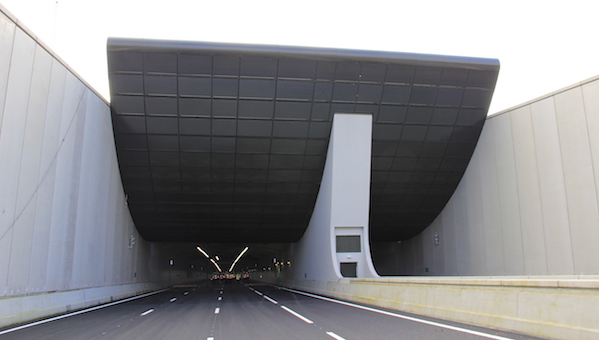
As a result of the construction of the new Coentunnel, opened in May 2013, the existing 40-year-old tunnel was closed for renovation. The older structure has now been reopened to traffic, bringing this major project to an end.
The two 750-metre tunnels, which are located under the port of Amsterdam, will relieve congestion on Amsterdam’s busy western ring road and ease the flow of traffic going north. The 200,000 customers expected on a daily basis will now have 8 lanes available to them, rather than 5 as was formerly the case.
Total project investment was €517 million. Coentunnel Company, a jointly owned subsidiary of VINCI Concessions, CFE and its subsidiary Dredging International, and their Dutch and Belgian partners will operate the infrastructure as a whole for 24 years in compliance with the contract.
This 5-year project was carried out by a consortium consisting of VINCI Construction Grands Projets and CFE, DIMI, TBI, Dura Vermeer, and Besix. The consortium delivered a turn-key solution that includes an automated traffic-management system.
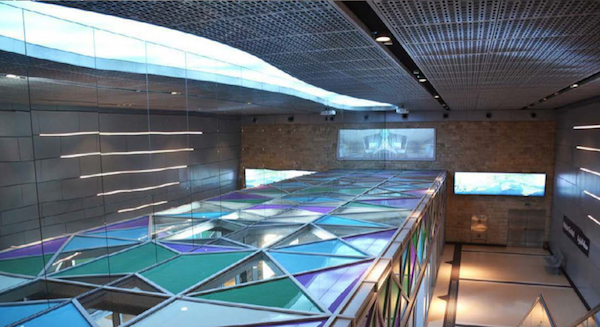
The new contract was signed in Paris on 23 June 2014 at a ceremony attended by François Hollande, President of the French Republic, and His Highness Sheikh Tamim Bin Hamad Al Thani, Emir of Qatar, who is on an official visit to France.
This design-build contract with a value of about €2 billion will be built by QDVC in a consortium with Alstom. It comprises construction of 25 stations and a depot, architectural and electro-mechanical works packages, integrated project management, delivery by Alstom, for €750 million, of 35 trains equipped with catenary-free technology, track-laying, energy supply and telecommunications as well as control systems. The light rail system is scheduled to begin operating in 2018 (yellow line) and 2020 (green, red and purple lines).
The city of Lusail, a new urban development with a population of 200,000 north of Doha, the capital of Qatar, will welcome up to 450,000 users per day. Sustainable development was a primary criterion in planning the new city. From the start, the design included the creation of a public transport system to limit greenhouse gas emissions. QDVC completed the civil engineering works on the first phases of the infrastructure (7 km of tunnels, 7 underground and 4 above-ground stations, as well as an access viaduct to the depot) and is currently building the Pearl station, which will connect the Lusail light rail with the Doha metro system, also under construction. In seven years, VINCI Construction Grands Projets has become, through QDVC, a major construction player in Qatar.
After handing over the country’s largest wastewater pumping station, the company is currently working on several projects: a new motorway on the outskirts of Doha (the New Orbital Highway), the Doha metro (southern works package of the red line) and the underground car park and landscaped gardens at the Sheraton hotel in the West Bay business district.
The Phase 2 civil engineering project, led by VINCI Construction Grands Projets alongside Bouygues Travaux Publics, a subsidiary of Bouygues Construction, and their Egyptian partners Orascom Construction and Arab Contractors, got under way in May 2009. More than 3,000 Egyptian workers were employed on the project, which was handed over five months ahead of schedule.
This achievement reflects the more than 30 years of experience that VINCI Construction Grands Projets and Bouygues Travaux Publics have acquired since the signature of the contract for Line 1 of the Cairo metro in 1981.
Developed in phases, Line 3 of the metro will ultimately cross the Egyptian capital east to west, connecting the airport with the districts west of the Nile over a distance of nearly 40 km. It is part of the large-scale plan designed to relieve traffic and limit pollution in Cairo, North Africa’s largest metropolitan area.
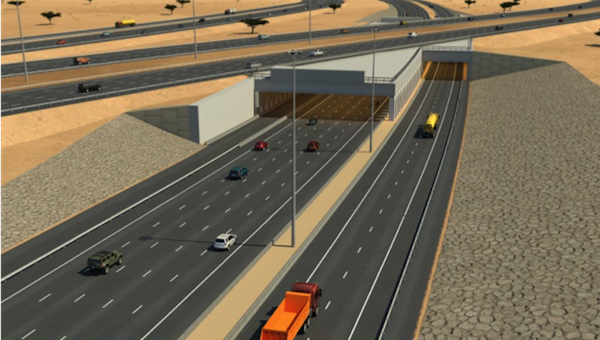
The €850 million contract covers the design and construction of 47 km of motorways, 6 viaducts, 17 bridges and underpasses and a 320-metre cut-and-cover tunnel. This motorway section will have a five-lane dual carriageway for light vehicles and two truck lanes in each direction. Work is to commence in May 2014 and take 36 months to complete.
The new highway, which is nearly 200 km long, will connect the new port of the Qatari capital with Ras Laffan, the gas-producing industrial city in the north of the country. The highway will bypass Doha and relieve current traffic congestion while preparing to accommodate projected road traffic increases.
This new success achieved by VINCI Construction Grands Projets in Qatar reflects the local roots of its subsidiary QDVC, which has positioned itself in seven years as a major player in the Qatari construction market. The company is currently working on the southern works package of the Doha metro’s red line, the light rail project in the new city of Lusail and the Sheraton underground car park and landscaped gardens in the heart of the West Bay business district. In 2012, QDVC handed over the country’s largest pumping station.

Entrepose Contracting and VINCI Construction Grands Projets, both subsidiaries of VINCI, have been awarded a contract with JSC Yamal LNG, owned by NOVATEK (80 %) and TOTAL (20 %), to perform an engineering, procurement, supply, construction and commissioning contract covering four cryogenic full-containment liquefied natural gas (LNG) storage tanks (each composed of a 9% nickel stainless steel interior container and a pre-stressed concrete external container) with a capacity of 160,000 cubic meters each.
These tanks will form part of a 16.5 million tons per annum natural gas liquefaction project, which will utilise the resources of the South Tambey Gas Condensate Field situated in the Yamal Peninsula in the Russian Federation.
In order to meet the project schedule requirements to make the first 2 tanks available in 2016, the detailed engineering, supply of the first equipment, camps, temporary facilities and piling works in the permafrost were started in June 2013 under a Letter of Award arrangement.
Entrepose Contracting and VINCI Construction Grands Projets have a track record of building more than 30 LNG storage tanks in 11 different countries over the last 20 years.
The two work packages involve the construction of four sections of a 3,600 meter long, 6-lane causeway coastal road between La Grande-Chaloupe and La Possession as well as the construction of an interchange at La Possession. The roadway dike has been specially designed to withstand the physical constraints of coastal construction especially 100-year flood waves.
With a combined contract value of 530 million euros for the two packages, the project is scheduled for completion in 2018.
GTOI and SBTPC have joined forces on this project, providing an entirely ‘local’ response to this contract of exceptional scale, with VINCI Construction Terrassement bringing in their expertise in major earthworks projects.

Jean-Luc Marx, Préfet de La Réunion et Didier Robert, Président de la Région Réunion lancent aujourd’hui officiellement la construction du viaduc de la Nouvelle Route du Littoral, réalisé en groupement par VINCI Construction Grands Projets (mandataire) et Dodin Campenon Bernard, filiales de VINCI Construction, Bouygues Travaux Publics, filiale de Bouygues Construction, et Demathieu Bard.
Ce viaduc en mer de 5 400 mètres, le plus long de France, qui longe le littoral, reliera Saint-Denis (chef-lieu de La Réunion) à La Grande Chaloupe. C’est un élément majeur de la nouvelle route du littoral dont deux voies seront dédiées aux modes de transport doux (bus, piétons/cycles) et qui remplacera l’actuelle route de corniche entre Saint-Denis et la Possession, exposée aux risques d’éboulements rocheux et de submersion par la houle ou lors d’épisodes cycloniques.
Les travaux du viaduc, d’un montant de 715 millions d’euros, s’achèveront en 2018. Ce viaduc sera réalisé selon une solution technique proposée par le groupement, par laquelle plus de 95 % des ouvrages seront préfabriqués à terre avant d’être posés majoritairement par voie maritime.
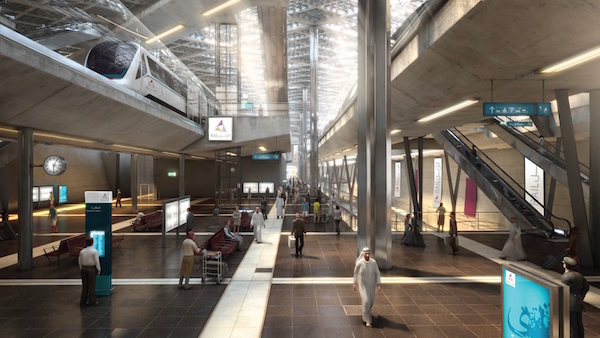
The contract, with a value of about €1.5 billion, covers design and construction of a dual-tube underground line with a length of 13.8 kilometres between the Doha airport and the Msheireb neighbourhood in the historic centre of the Qatari capital.
The future red line will run along the Gulf coast. One of the project’s challenges will therefore be to prevent water ingress during tunnel boring operations. Five earth pressure tunnel boring machines with an outside diameter of more than 7 metres will operate simultaneously. The contract also includes the design and construction of six underground stations, 51 safety connections between the tubes and three emergency evacuation shafts.
The works will take five years to complete and involve up to 3,000 people.
The works will be carried out with minimum impact on road transport in this part of the city, where traffic is very heavy, thanks to an 8 kilometres system of conveyor belts that will remove excavated materials. The project’s impact on the environment will also be minimised, with the installation of noise barriers and systems to control dust emissions to the atmosphere.
The red line will be the first of the four planned Doha metro lines. The operation is one of the major projects carried out under the Qatar Rail Development Program, which aims to develop transport infrastructure in Qatar, notably in the run-up to the 2022 FIFA World Cup.
QDVC is currently building the light rail system for the new city of Lusail north of Doha. It will be Qatar’s first rail transport system.
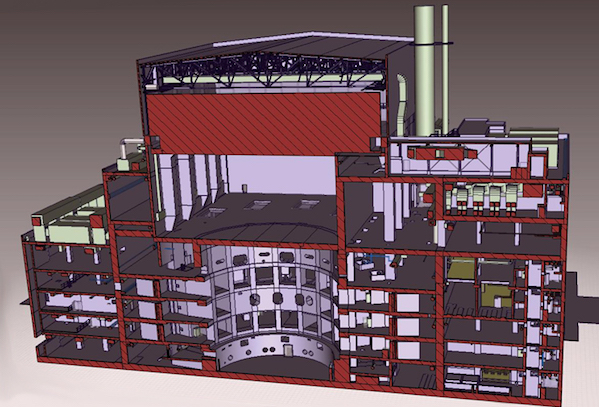
The contract is worth around €300 million and is expected to run for five and a half years.
The design studies will begin in April 2013 and the main civil engineering works in autumn 2013. The main building will house the Tokamak reactor, a 28 m-diameter cylinder, 29 m high and weighing 23,000 tonnes). With the two adjacent annexes, this will form a concrete structure 120 m long, 80 m wide and 80 m high.
The other auxiliary buildings comprise the Assembly building, a two-story Control Building and miscellaneous industrial buildings.
The contract also provides for several large (4m x 4m, 40 tonnes) anti-radiation, highly pressure-resistant nuclear doors, to be designed and built by a consortium comprising Cegelec (a subsidiary of VINCI Energies) and Sommer.
The International Thermonuclear Experimental Reactor (ITER) project is a first-of-a-kind global collaboration in the field of energy. It will be the world’s largest experimental fusion facility and is designed to demonstrate the scientific and technological feasibility of fusion power.
Fusion research is aimed at developing a safe, limitless and environmentally responsible energy source. Europe will contribute almost half of the costs of its construction, while the other six Members to this joint international venture (China, Japan, India, the Republic of Korea, the Russian Federation and the USA), will contribute equally to the rest.
Fusion for Energy
Fusion for Energy (F4E) is the European Union’s organisation for Europe’s contribution to ITER.
One of the main tasks of F4E is to work together with European industry, SMEs and research organisations to develop and provide a wide range of high technology components together with engineering, maintenance and support services for the ITER project.
F4E supports fusion R&D initiatives through the Broader Approach Agreement signed with Japan and prepares for the construction of demonstration fusion reactors (DEMO).
F4E was created by a decision of the Council of the European Union as an independent legal entity and was established in April 2007 for a period of 35 years.
Its offices are in Barcelona, Spain.
www.fusionforenergy.europa.eu
www.youtube.com/user/fusionforenergy
twitter.com/fusionforenergy
ITER
ITER is a first-of-a-kind global collaboration. It will be the world’s largest experimental fusion facility and is designed to demonstrate the scientific and technological feasibility of fusion power
Fusion is the process which powers the sun and the stars. When light atomic nuclei fuse together to form heavier ones, a large amount of energy is released. Fusion research is aimed at developing a safe, limitless and environmentally responsible energy source.
Europe will contribute almost half of the costs of its construction, while the other six Members to this joint international venture (China, Japan, India, the Republic of Korea, the Russian Federation and the USA), will contribute equally to the rest.
The site of the ITER project is in Cadarache, in the South of France.
www.iter.org