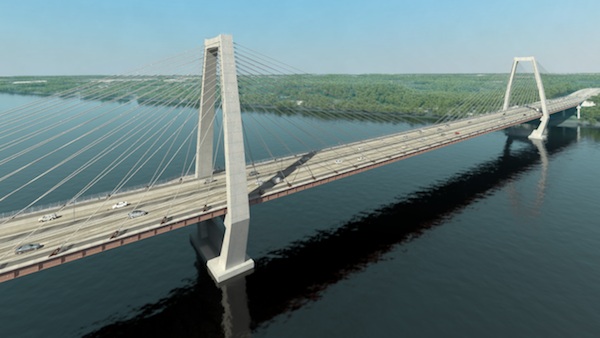
The public-private agreement is for a 2,500 feet-long (762 metres) cable-stayed bridge across the Ohio River that will link Louisville, Kentucky to Southern Indiana, a 1,680 feet in length (512 metres) twin-bore tunnel on the Kentucky approach to the bridge, and 19 additional bridges, along with associated roadway improvements and other related infrastructure work. The new East End Bridge will be located about 8 miles (13 km) from downtown Louisville, connecting the Gene Snyder Freeway to the Lee Hamilton Highway.
The works, scheduled to take 3.5 years, will be executed by a design-build joint venture including Walsh Construction (60%), VINCI Construction Grands Projets (40%) and Jacobs Engineering for the engineering works. Construction is set to commence in the summer of 2013 and completion is expected by autumn 2016.
The total value of the contract is around $1 billion (approximately €787 million).
The consortium, led by VINCI Concessions, will be responsible for the operation, routine maintenance and rehabilitation of the infrastructure for a period of 35 years. It will be paid through license-fees calculated on the basis of the infrastructure’s availability.
The East End Crossing is part of the broader Ohio River Bridges Project, one of the largest transport improvements in the United States. It will address traffic congestion issues and improve transport safety.
The contract is worth $366 million.
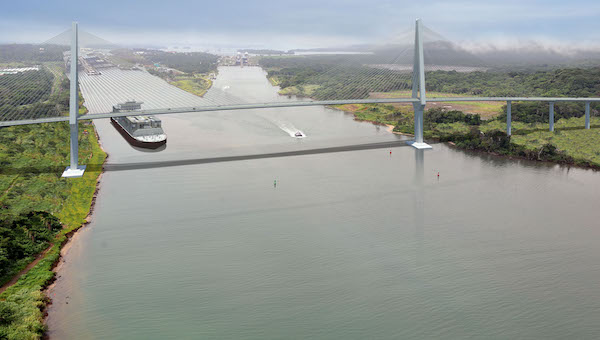
The bridge will be located 3 km north of the Gatun locks, near the city of Colon. The contract covers construction of a 1,050m-long cable-stayed concrete bridge carrying two lines of traffic in each direction, with a central span of 530 metres and pylons with a height of 212.5m. It will have a vertical clearance of 75m above the canal. The Atlantic Bridge will be the longest concrete cable stayed bridge in the world with a central span of 530 metres.
It will notably allow passage of the largest container ships (Post-Panamax), in accordance with the canal expansion programme. It will also allow vehicles to cross the Panama Canal on the Atlantic side, whether or not the locks are in operation.
To avoid disrupting navigation in the canal, it will not be possible for the work to be carried out in the waterway itself, which means the deck will have to be cast in place. The contract also includes construction of access viaducts on either side of the bridge with a total length of 2 km, together with connections to the existing road network.
Work is expected to start in January 2013 and last 3 ½ years.
This contract, which marks the historic return of a French company to the Panama Canal, is yet another addition to VINCI Construction Grands Projets’ prestigious portfolio of bridges: Pont de Normandy (France), Severn Bridge (United Kingdom), Confederation Bridge (Canada), the bridge over the Tagus (Portugal), and Rion-Antirion (Greece).
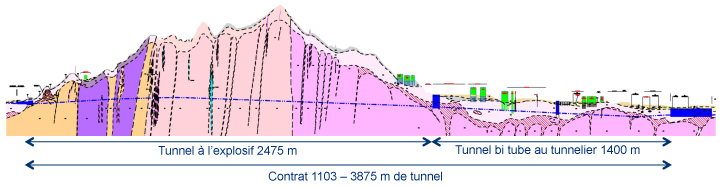
The contract comprises the construction of 2,475 metres of drill and blast tunnel and 1,400 metres twin tunnels to be excavated by means of a slurry TBM with 7.4 metres diameter.
The works commence 22 October 2012, with a contract duration of 68 months.
The new Shatin to Central Link is split into 10 main contracts and provides for the realization of a 12 kilometres underground mass transit line, the construction of 4 new stations and the reconfiguration of 2 interconnecting stations.
VINCI Construction Grands Projets has already participated in the construction of the Hong Kong Mass Transit railway between 1998 and 2002, with the completion of 5 tunnels under the Black Hill Mountains for the extension to the town of Tseung Kwan O.
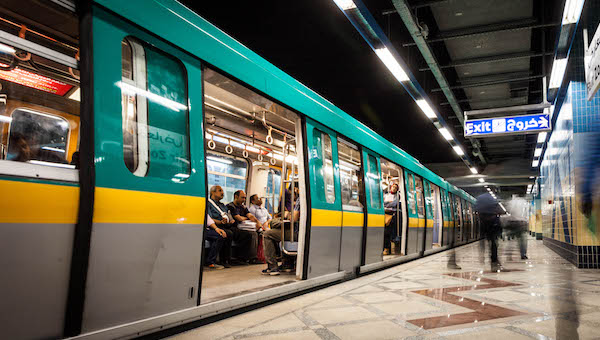
Once completed, Line 3 will cross the Egyptian capital from east to west, from the airport to the districts west of the Nile. The development of the Cairo metro system is part of a large-scale plan aimed at serving the transport needs of the Greater Cairo area up to 2022. It will help to reduce pollution in Africa’s largest metropolitan area.
3,500 people, including 85 expatriate staff, worked on this project, which took 51 months to complete. The project was built by a consortium, led by VINCI Construction Grands Projets, comprising Bouygues Travaux Publics, Orascom and Arab Contractors. The €235 million Phase 1 civil engineering contract covered construction of a 4.2 km tunnel section and five stations. Meanwhile, VINCI subsidiary ETF-Eurovia Travaux Ferroviaires led the consortium responsible for the track works package. This included the supply and laying of 11 km of track and the power rail in the tunnel.
VINCI Construction Grands Projets built the first two metro lines in Cairo, which now serve nearly four million passengers per day, and is currently working in a consortium with Bouygues Travaux Publics, Orascom and Arab Contractors on Phase 2 of Line 3 (6.5 km tunnel and five stations); Phase 2 is currently 60% completed and is scheduled for handover in early 2014. The National Authority for Tunnels (NAT) is working on the design studies for Phase 3.
VINCI Construction Grands Projets have a long track record in major projects in Egypt and recently signed the design-build construction contract for the new Assiout dam on 12 December 2011.
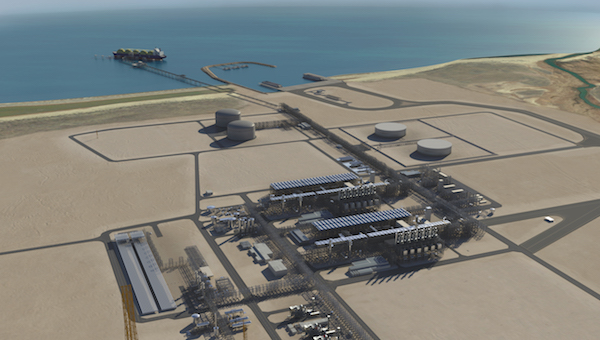
ENTREPOSE Projets, a subsidiary of ENTREPOSE Contracting, and VINCI Construction Grands Projets, both subsidiaries of VINCI, have just signed, in a joint venture with Thiess Pty Ltd, a subsidiary of Leighton Holdings Limited, an engineering, procurement and construction contract for approximately AUD 500 million (about €400 million) covering two full containment liquefied natural gas (LNG) storage tanks with a capacity of 150,000 cubic metres each as well as two condensate storage tanks with a capacity of 120,000 cubic metres each.
The contract is forecast to create about 475 jobs in Western Australia’s Pilbara region, and 75 per cent of the content will be Australian, including 55 per cent West Australian. There will also be significant Indigenous involvement.
The Chevron-operated Wheatstone Project, a LNG and domestic gas project managed by Bechtel Australia, is located near Onslow in the North Western Australian region and represents one of Australia’s largest resource projects. The project will commence immediately with construction to last from 2013 to 2016.
ENTREPOSE Projets and VINCI Construction Grands Projets have built more than 30 LNG storage tanks in 10 different countries over the last 20 years, including three 180,000 cubic metres capacity tanks at the Gate regasification terminal in the Netherlands in 2011.
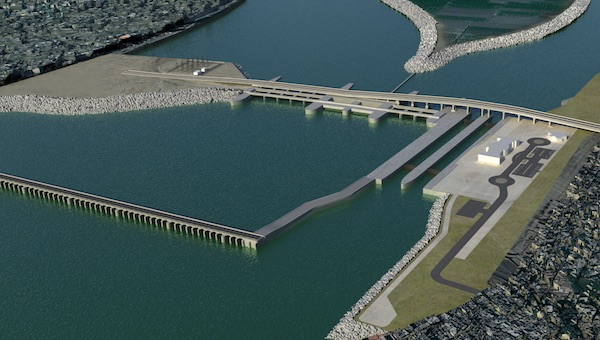
The works, valued at 266 million euros, will be carried out by a consortium composed, in equal parts, of VINCI Construction Grands Projets (leader), Arab Contractors and Orascom. The works will start on 2 May 2012 and should take a little over 5 years to complete (64 months).
Located on the Nile, some 250 kilometres to the north of Luxor, the new Assiut dam will replace an existing dam, built early last century 400 metres further upstream.
This project aims to regulate the flow of the Nile, for irrigation purposes and for the production of electricity (32 MW, produced by four 8 MW turbines). It will have 2 locks, to allow through river navigation.
The project is being financed by KfW and the Egyptian government.
This new contract will add to the Group’s numerous references for Egypt, where it has been present for over a century. After delivering the Aïn Sukhna rolling mill and the Naga Hammadi dam in 2008, VINCI Construction Grands Projets is currently working on phases 1 and 2 of Line 3 of the Cairo Metro, having already led the construction of Lines 1 and 2. The diversity of the projects carried out in Egypt clearly demonstrates the wide range of expertise of VINCI Construction Grands Projets, and testifies to a long term relationship with the Egyptian authorities.

The “Túneles de Acceso Principales del Proyecto Nuevo Nivel de Mina El Teniente” covers drilling and blasting two 9 km tunnels, each with an average cross section of 65 sq. metres, together with two intermediate access tunnels totalling 6 km. The first of the main tunnels is for transporting personnel; the other is for the ore. The tunnels will enable a new mine level to be created in El Teniente, the world’s biggest underground copper mine.
El Teniente is located at an altitude of between 1,500 and 1,900 metres, 80 kilometres to the south of Santiago, in the Libertador General Bernardo O’Higgins region in the Andes.
The works, which are scheduled to start in October 2011, will take 40 months to complete.
VINCI Construction Grands Projets is a major player in underground works, as illustrated by its current contracts, which include the Hallandsås rail tunnels in Sweden, Liefkenshoek rail tunnel in Belgium and the Cairo metro in Egypt.
Soletanche Bachy is one of the world leaders in ground technologies and has been operating in Chile’s mining sector for many years.
From left to right: Roberto Morrison (Soletanche Bachy Chili), Lionel Galis (VINCI Construction Grands Projets), Jean-Louis Dupoirieux (VINCI Construction Grands Projets), Roberto Madrid (Codelco), Yves Chiffoleau (Soletanche Bachy France), Juan Carlos Caprile (Constructora Vinci Chile)
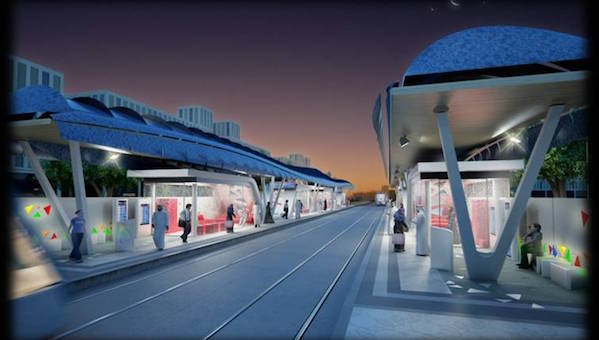
The €374 million design-build contract covers civil engineering works in the eight underground stations, a viaduct across the motorway linking Doha with the northern part of the country and preliminary works on an LRT depot and maintenance workshop. The work is expected to take 38 months to complete.
The award of this new phase of the works attests to the excellent work done by QDVC in the previous phases (earthworks design studies and execution, followed by civil engineering works in the cut-and-cover tunnels and ventilation shafts) of this modern project, in which the construction of a new city is starting with its public transport system (LRT).
The new city of Lusail is made up of 37 sq. kilometres of waterfront land master planned into 19 mixed-use districts. It will accommodate approximately 200,000 residents and as many daily workers and visitors.
The LRT will serve the entire city of Lusail and will in future interconnect with the regional transport network. The Lusail Light Rail Transit System has therefore been handed over to the newly formed Qatar railway authority, Qatar Railways Company.
The full Lusail LRT project features four lines covering a combined distance of 30 km, eight underground stations and 25 at-grade stations. It is being built in several design and construction phases. The design phase got under way in August 2007, followed by earthworks and excavations for cut-and-cover tunnel construction in March 2009, tunnel construction in March 2010 and preparation of underground station construction in June 2011. The next and final phase of the works will include rolling stock and systems. Handover of the turnkey project is set for 2016.
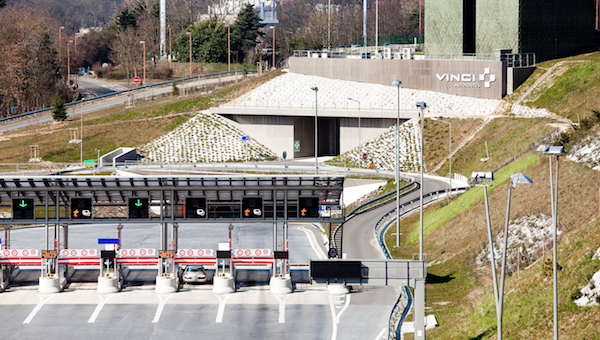
The second section of the A86 Duplex, covering the 5.5 kilometres between Vaucresson and Vélizy, was opened to traffic at 1 pm on the next day, Sunday 9 January 2011, six months ahead of the date provided for in the concession contract signed by Cofiroute* with the French government.
The A86 Duplex offers drivers substantial time savings under safe and pleasant driving conditions. It will now take less than 10 minutes to complete the 10 kilometres trip between Rueil-Malmaison (Hauts-de-Seine) and Vélizy (Yvelines), compared to over 45 minutes on average using surface roads. The first section of the A86 Duplex, opened to traffic on 1 July 2009, cut travel time between Rueil-Malmaison and Vaucresson to just five minutes. It is used by over 13,000 vehicles on average every day, with travel “peaks” of 15,000 vehicles/day.
Designed, built, financed and operated by Cofiroute, this new-generation urban tunnel forms the final, western, link of the A86 motorway, the second ring road in the Paris region after the inner ring road (boulevard périphérique). The tunnel, which primarily facilitates travel between La Défense and Saint-Quentin-en-Yvelines / Vélizy, major economic hubs in the Paris Region, makes a major contribution to improving the mobility of residents.
The A86 Duplex, reserved for light vehicles, consists of two superimposed decks carrying traffic moving in opposite directions. This one-way system eliminates the risk of head-on collisions. Sophisticated monitoring equipment and systems enable rapid detection and handling of any incident.
Staff at the 24-hour Cofiroute operations centre at Reuil-Malmaison monitor the safety and comfort of users and can provide front-line emergency assistance in the event of an incident. Over 100 employees have received special training and carry out regular drills.
Thanks to its stringent safety features and controls, the first section of the A86 Duplex was named as “the safest tunnel in Europe” by the European Automobile Clubs and Touring Clubs in their 2010 tunnel assessment programme (EuroTAP) covering 26 road tunnels in 13 European countries.
The A86 Duplex was built by VINCI companies for Cofiroute, which will be operating it under concession until 2086. It represents an investment of €2.2 billion.
*Cofiroute (1,895 employees) operates a network in centre-west France (A10, A11, A28, A71, A81, A85 and the A86 Duplex). A private-sector company since its creation in 1970, Cofiroute’s shareholders are VINCI (83.33 %) and Colas (16.67 %). It also has operations in the United States, the United Kingdom and Germany and records about 120 million transactions a year. Cofiroute’s inter-urban network is ISO 9001 and ISO 14001 certified.
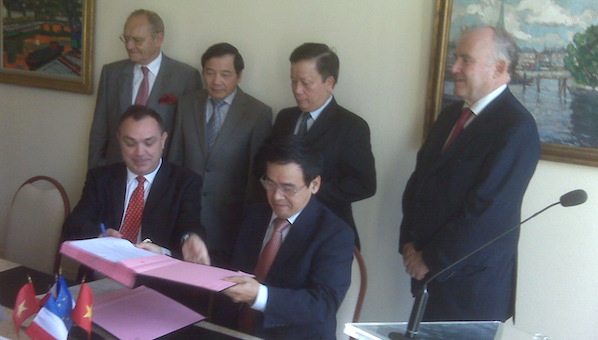
The signing took place in the presence of Mr Dominique Bussereau, France’s Secretary of State for Transport, and Mr Nguyen Hong Quan, Vietnam’s Minister of Construction.
The agreement provides for a first phase of exclusive discussions with a view to signing a design-build contract.
Located on the main north-south corridor between Hanoi and Ho Chi Minh City (RN 1A), the project calls for widening 9 kilometres of road and building a new 11 km section that includes two tunnels (5.5 km and 0.350 km), three bridges with a total length of 1.260 km and approach roads totalling 4 kilometres. It will eliminate the final dangerous mountain pass crossing on the RN 1A.
The value of the project is estimated at $600 million.
In parallel, Deo Ca Investment JSC signed three other MOU: one with Egis for the studies, another with Apave for works monitoring and quality control, and the third with Crédit Agricole and Société Générale for the financing.